Five Minutes

7/4/2026
Jonathan Lundgren
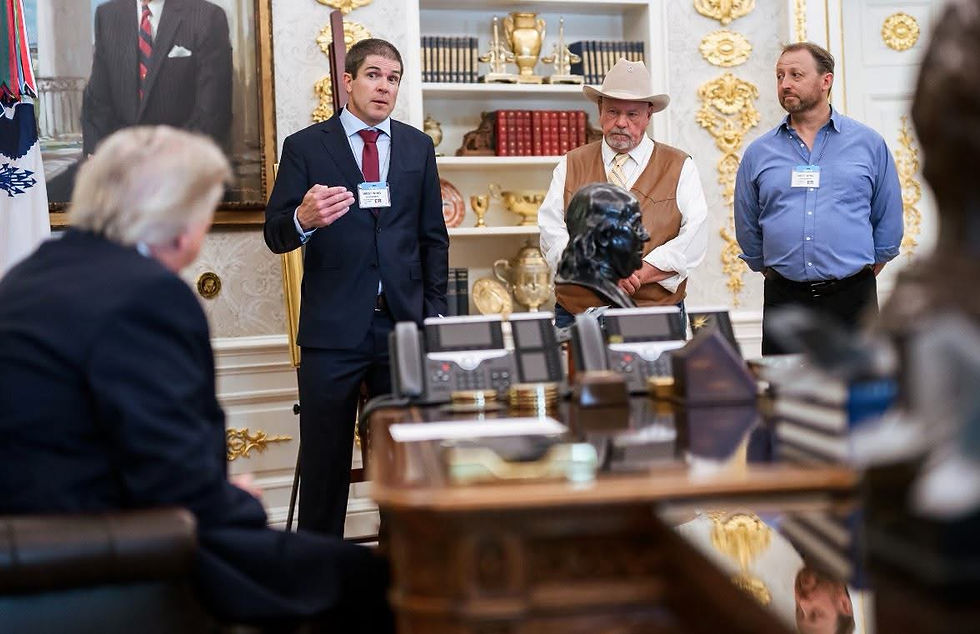
When asked to come to the Oval Office to speak to the president about an issue that you are passionate about, the answer should be an enthusiastic “Yes”.
So why did I struggle so much with this decision?
I was recently invited to the White House to discuss regenerative agriculture with President Trump and his Cabinet along with three top farmers in the regenerative movement. The auspices of the visit were to come to the newly paved Rose Garden of the White House for a dinner in honor of American Farmers. Four of us farmers were told that there may also be an Executive Order regarding regenerative agriculture signed, and the President wanted to discuss it with us.
For a week prior to the event, I laid awake at night trying to decide what to do.
Because the meeting in the White House came about as I am trying to keep my farm, family, and small non-profit afloat amidst so many federal policies that are dragging the battered and weeping bodies of these things that I hold dear around by the hair. The deregulation of agrichemicals and promotion of industrial agriculture that is literally killing our farmers so that corporations can get rich is so against our nation’s health and security. It hasn’t gotten better. It has gotten worse. Amidst so much contrary behavior, could support of regenerative agriculture from the administration be real?
The Executive Order on Regenerative Agriculture can instigate major investment by the administration into regenerative agriculture, and put agrichemicals and their human health costs under scrutiny. Soil health and conservation agriculture have been a weak afterthought of decades of legislation, current politics included. For the first time in my life, more voters than I have ever seen are voting not for a party, but for a food system that can keep their families and communities safe.
I consulted with many people, trying to decide the right thing to do. Was the fall out worth the potential benefit? Was I just being used to greenwash the administration’s recent contrary decisions? Was it even worth my time to try?
In the end, Ecdysis Foundation was founded on the idea that long shots that matter are worth taking.
Christina and I got on an airplane, and headed to DC.
From the minute it was presented to the President, I wasn’t sure that Trump was going to sign the Executive Order. Rather than be simple poster children for the movement, it was evident that the farmers in that room were there to defend regenerative agriculture. The biggest hang up was in how agrichemicals were being viewed in the food system strategy that laid on the President’s desk. Regenerative agriculture replaces agrichemicals and tillage with other management tools.
HHS clearly spearheaded the EO and the meeting. They had crafted the document with input from the USDA, and chose the words very carefully. Calley Means, Stephanie Spears, and RFK Jr were not leaving the signing of this EO to fate. Secretary Rollins was cautiously supportive. For decades (and up to now), the USDA has been most interested in keeping industrial agriculture in business while giving a leftover scrap of their resources to building a future-thinking, regenerative food system.
Farm Bureau told the president that he would lose their vote if he signed the Executive Order on Regenerative Agriculture. That the document on the President’s desk was incriminating by saying that agrichemicals in the food system were making Americans sick. And Zippy explained that his own relationship with the President was at stake.
President Trump’s hand waivered over the document.
For around 45 minutes, the debate waged on. Calley Means fended off corporate advocacy for agrichemicals, while RFK Jr explained that this was probably the most important EO that the President would sign in support of the health and future of the American People.
The whole discussion was made more complicated by a Supreme Court ruling that was made just hours before our meeting. Although not on the script, I felt compelled to bring the issue up to the President. “Mr. President, this morning the Supreme Court decided that farmers whose families are poisoned by pesticides have no recourse to sue the pesticide companies. This is a huge punch in the gut to making America healthy again.” Turning to Ms. Rollins, President Trump wanted to know the nature of this court decision. Somehow, Rollins and Farm Bureau tried to make the case that the court decision was a win for farmers.
I explained how in the past 10 days alone, my farm had been sprayed every day by the county, the state, and local farmers. That the staff, my family, and the residents in my community call the symptoms that many of us have this time of year “spray flu”. “But the farmers need these sprays, don’t they?” the President asked. “I am an entomologist, Mr. President. I have been in their fields. No, they do not need these sprays.” It isn’t very often that being an entomologist has come in so handy.
The data that Ecdysis Foundation has generated through visiting 2,000 farms across the U.S. over the past 4.5 years weighed heavily on the discussion. “Mr. President, the most striking data we have generated from our work is that row croppers in the U.S. have twice the asthma rates, 3 times the clinical depression, 3 times the cancer rate, and a 2,600 fold increase in Parkinson’s rates compared to the rest of society. We are killing our farmers.” A pause for effect. “But regenerative agriculture is a huge win for farmers. 90% of regenerative row crop farmers have abandoned all insecticides and fertilizers. Two-thirds have abandoned all synthetic fertilizers and herbicides. The protein content of the wheat produced is twice as high as conventional wheat tested. Regenerative wheat yields are equivalent to national averages, and the profit potential is higher. This is the answer that American farmers have been looking for.”
The President finally came to a decision.
In the end, the HHS team and the farmers convinced President Trump to sign the order.
I think it needs to be clear. Farm Bureau and Mr. Duvall aren’t enemies here. Conventional farmers are not enemies here. Consolidated, corporate agriculture is how we got here. Greed is our enemy. A cultural movement away from our families, communities, and the natural world that produces our food is the enemy. Farmers and consumers never win in a globalized, industrial food system.
As we left the White House, Mr. Duvall explained that he knew that our little band of farmers were trail blazers. “Farmers don’t need the government telling them what they can and can’t put on their fields.” He explained. “The trouble comes when what they spray on their fields makes my family sick.” I said. We left the conversation with me saying “If we are trail blazers, and this is the future, then we need you, Mr. Duvall. We need your help. Let me talk to the farmers of Farm Bureau.” Because regenerative agriculture is not scary; but it is different. He said he would call to set something up. And I hope he does.
I have been asked the question “Why you?” many times since the meeting. The other farmers are leaders of this movement, and it makes sense that they were there. They have helped show us a new path. And every answer I give seems to fall flat. I just can’t get over the fact that there were way better people than me that should have been in that room.
Five minutes of words seem like a really frail and inadequate tool to help convince extremely influential people to get behind the future of humankind. To prioritize the safety of our families and our rural identity and the environment we live in. That’s all I had to work with…5 minutes of words. But those were 5 minutes that 350 million Americans who are hurting right now are never going to get.
So I went in and I did the best I could.
I don’t know what comes next. There has to be integrity in our legislators and there needs to be a vision of a new food system that is supported by all facets of our government. I am cautiously optimistic that we will move the needle on reforming our food system towards one that supports farmers and their families, the land, and communities. I have to hope for that.


Hi Jonathon, followed you for years on Beyond Pesticides. Good luck with your new farm and thanks for fighting the good fight. God bless you and your family. Cheers!
Thanks for going in there and providing the facts on how this can be done better, safer, healthier for all!